
IRONMAN Lanzarote: A New Way to Race
- paceplan.co.uk
- Jul 15, 2018
- 17 min read


Heading home after Club La Santa Ironman Lanzarote 2018. Pro triathlete Jesse Thomas has been quoted saying this is “the toughest IM in the world”. This was my fourth Ironman race and this time around my goal was to compete, rather than simply complete. I took 1 hour 50 minutes off of my previous Ironman personal best – a breakthrough performance, achieved through training hard and pacing smart come race day. Read on to find out how...
My journey so far…
I took up triathlon in 2012, and since then I have competed at a couple of races a year alongside local running events, up to the half marathon distance. I towed the start line of my first Ironman back in 2013 at IM Wales, completing the race in 14:22:44. I returned to the Iron distance in 2015, racing Ironman UK and Ironman Wales again – finishing in 14:18:38 and 13:58:49.
After my Ironman races in 2015 I felt quite dejected, as my results at Bolton and Wales were an hour or so off what I thought I could achieve back then. I could run a half marathon in 1:30:00 but my marathon in an IM was approximately 5hrs - surely I should be able to get closer to 4hrs? Deciding to take a break in 2016 was a good decision, as it gave me a chance to review and reflect on the training I had completed over the previous 3 years. I am engineer and I’m all about problem solving, so I decided to treat my lacking performances in the same way I would address an engineering problem.
Back in 2015, I genuinely thought I was training well…. I had a good plan from a great coach (Campbell), I had accumulated a few years’ experience in triathlon, I had a TT bike, a Garmin watch, HR data and some fancy wheels. All these things should make me faster right? Well, yes they probably would have if I’d been doing the training to back them up. The training plans were great but I wasn’t actually following them. If you asked me at the time I thought I was ticking each day off. In reality I was shortening the sessions. I would get to the pool before work with not enough time to complete the full swim session; a 3hr ride would turn into a 1hr ride with a 45min café stop followed by a 1hr pootle home. My long runs were far too fast meaning I would end up burning out and jogging slowly after 10miles or I would pick up an injury and have a week or two off. My TT bike was a pretty serious bit of kit, but looking at all the event pictures I was always photographed sat bolt upright, not on the aero bars… so much for spending £££’s on those aero gains. I quite literally had more data than I knew what to do with. I had a Garmin which gave me information about pace and heart rate, but I didn’t actually know what pace or heart rate I should be holding. I read some magazine articles which gave me a rough guide but then I didn’t use this in my races. I raced too hard, too early and ended up walking during the marathon – ultimately compromising my entire race through poor pacing and preparation.
In 2016 I decided it was time to educate myself so I could make full use of all this shiny data I was hoarding. I came across Training Peaks, which is a great source of information and a powerful website that allowed me to review in detail all the workouts I had uploaded to Garmin since 2013. This is when I realised the extent of the holes in my training and the errors in my race pacing. I knew I had to make some changes if I was going to progress in triathlon.
By late summer 2016, I had started to train consistently and my fitness was improving. In September, my girlfriend and I headed out on holiday to Majorca to support some friends, Chris and Campbell (my old coach), who were racing the Ironman out there. It was with a new perspective that I watched the race, witnessing the contrast between the athletes who controlled their race and finished strong versus those whose race began to unravel (just as mine had previously) due to poor planning and pacing. I realised just how important realistic pacing and nutrition was going to be for me to achieve my goals at my next race. Both Chris and Campbell had strong races, finishing in under 11hrs. Having trained with both of them, I knew they were quicker than me – but not by such a huge margin. If they could go sub-11hrs, I should be capable of going under 12.5hrs. Ironman support crew cowbells safely stowed away for another year, discussions with Chris after the race soon lead to the possibility of us both racing Lanzarote in 2018. Given that this was at the end of 2016, 2018 seemed a long way off but the seed had been planted.
Coming into 2017, I had a good handle on my training. I was doing little and often, focusing on quality sessions at the correct intensity. My old coach Campbell had given me advice about the things I needed to change when I was training for IM UK and Wales in 2015, but I just hadn’t taken it in. 2017 was the year that I started to make these changes and work on my weaknesses. I kept in touch with Campbell, as he was now coaching my girlfriend who was getting more serious about triathlon and had decided to take on her first half Ironman. We both entered IM 70.3 Zell am See in Austria – a relatively tough half due to the altitude and a bike course with 870m of climbing up into the surrounding mountains.
In May 2017, registration for Ironman Lanzarote 2018 opened up… I was tempted. My friend Chris and I egged each other on. He had already raced Lanzarote in 2015 and felt he had unfinished business on that island. I had unfinished business with the Ironman distance full stop. Fast forward 24hrs, the deed was done and we were forwarding each other our entry confirmation emails as proof that we were actually going to do this. So now I had a 70.3 and my 4th Ironman on the horizon. It was time to think seriously about what I was going to do differently this time.
I started by getting a proper bike fit from Rich at Corley’s Cycles in Milton Keynes. Rich was ace, looking at everything from the cleats on my shoes to the limitations imposed by my flexibility. Small tweaks here and there to the seat position and the cockpit made a big difference - not only was I comfortable on the aero bars, making me quicker straight away, I was also better positioned to run after my rides.
Next, I set myself some targets for Zell am See. I wanted to complete the 1.9k swim in under 35mins, the 90k bike in under 3hrs and the half marathon in 1hr 40mins. These goal were based on recent performances in training/racing, but all the same they were ambitious targets.
My training went well, taking ownership of it by writing my own plan helped to keep me motivated, and I was able to hit all my set targets in training. I invested in a bike power meter, which really helped me to control my training intensity and to ride efficiently. I was putting in more hours than ever before, training between 8-12hrs a week and ensuring every 4th week was recovery focused. The results coming in proved my training was working. I raced two half marathons, the first in May at Milton Keynes where I set a new PB of 1:28:48 and the second in June at Hitchin Hard Half where I ran a 1:29:06 over a hilly course finishing 12th overall. In July I placed 2nd at my local sprint triathlon – it wasn’t a hugely competitive field, but nonetheless I got a new PB over that distance finishing in 1:02:31. My last race before my taper started was a standard distance race where I qualified (via a roll down spot) for the GBR Age Group team to race at the ETU Standard Distance Championships in Estonia. My girlfriend Jenny had already qualified for this race and we had flights and accommodation booked, so I thought it rude not to accept my slot.
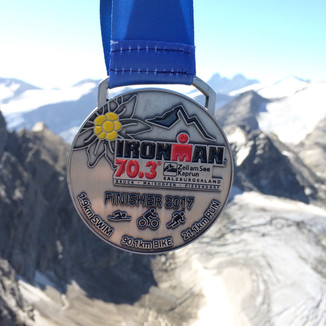
Before I knew it, August arrived and we set off on our long drive to Zell am See. This race was a big learning experience for me. The swim was ace – I came out of the water after 00:34:11 and I still felt fresh. On to the bike and up into those mountains. I raced the bike leg hard, but controlled, using my power meter to help achieve a 02:57:27 split – achieving my goal time of under 3hrs. “Yes! I’ve got this” I thought as I started the run a little faster than I had planned but I felt good so why not... this is a race after all. To do a 01:40:00 run split, I would need to average 4:45/km or 7:38/mile. I ran my first km at 4:20/km pace and by the end of the 2nd kilometre, my pace had already started to drop below 4:30/km. At 5km I was running slower again, around 5:00/km. From that point onwards I just got slower. I felt horrible and I was clearly in need of nutrition because I was drinking and eating lots at the aid stations. I managed to keep running mostly with a little walking thrown in, finishing with a 1:55:24 run split. Jenny had a brilliant performance - she had followed Campbell’s training plan to the letter and her progression was impressive.


So what did I learn…
Firstly, my longest training day was about 4hrs so I hadn’t tested my endurance or nutrition for the race beyond that time. School boy error number 1. I also learnt that a half marathon can feel a lot longer, and a hell of a lot tougher if you pace it poorly. I wasn’t disciplined at the start and I didn’t stick to my goal pace, meaning it soon fell apart because I’d tried to run quicker. School boy error number 2. Finally, I learnt that I needed help to cover all bases in my training… I needed a coach to give that much needed perspective and advice. I enlisted Campbell to coach me to the start line of Ironman Lanzarote and I knew that, this time, I needed to follow his advice. When it came to the next steps, I knew that I still wanted to have an element of taking ownership of my training. I am very data driven (I have pace HR and power data coming out of my ears) so I set to work to use this data to create a realistic pace plan for me to race and train with, that would complement the training Campbell laid out for me. In the months after Zell am See I backed off the training and got some much needed recovery, followed by a bit of cross-country running and some half marathon training. By mid-December, as most people were winding down for Christmas, I started my 23 week training plan for Ironman Lanzarote.
I started 2018 training well and feeling positive. In a “3 buses at once” type situation, I’d finally got a ballot slot for the London Marathon after 5 years of trying. I have never run a marathon in its own right before so I was excited to see what I could do. However, I told Campbell what I wanted to achieve at Lanzarote (optimistically targeting 11.5hrs) and he advised “too many events, you need to focus”. To have a chance of achieving my goal for Lanzarote, I would have to defer my London Marathon entry until 2019. Reluctantly I took his advice, I needed to trust him and follow his plan. I couldn’t repeat the same mistakes from the past by dismissing his advice and doing my own thing. I did however, have a place at the ‘Big Half’ in London in March – a half marathon taking in some of the major London sights and an opportunity to show Sir Mo Farah how it’s done… Campbell said as I had deferred the Marathon slot I should enjoy the Half. This was my London experience for the year, so I should go for it and see what I could do. My training had tapered off so I was rested and in form come race day. But I had been training for an Ironman not a half marathon, all my long runs were at easy conversational pace, in comparison to the very high intensity required for a fast half marathon. I turned to the data driven Paceplan model that I’d been working on to see what I should be aiming for. It predicted me at around 1:26:30 as a conservative Paceplan. That was quite a bit quicker than my current personal best 1:28:42, but according to my Paceplan if I raced aggressively I could maybe go a minute quicker targeting a 1:25:30. This would mean running 4:03/km average pace, when all my long training runs had been at 5:00 to 5:20/km. My model showed me with my aggressive plan at 17km I would start to hurt. Bring it on. I decided to race following my aggressive Paceplan. At about 10km I had settled in to a rhythm, holding my 4:03/km pace and I was running with a group of 5 other runners. I was comfortable but they were panting and looked laboured. At about 15km the group I was running with started to fade one by one – by 17km I was the only one left. I held my pace but it wasn’t feeling quite so easy now. I was catching some runners but others were coming passed me, it was hard to stay focused and on pace but I kept it together in the closing kilometres. As I turned the last corner I could see the clock - it said 1:25:20 and I sprinted for the line. My chip time was 1:25:13 and as the medal was hung around my neck I was overcome with emotion, not only because I had achieved a new PB but because I knew that in Paceplan I had developed something powerful. Using the Paceplan model, I’d been able to pace my race perfectly – crossing the line knowing I had truly been able to achieve my potential on that day.
In the following weeks my training volume built up with more race simulation training sessions. Campbell had planned some big weekends of training at race pace including back to back swim, bike and run sessions. I used these to test my Paceplan model, to tweak it to try and break it. But it seemed to give me a very good guide to race to. I used it again when I ran the Bedford 20 mile race straight after 3 hours on the bike (riding at my half Ironman bike power). I targeted a 2:45:00 for the 20 miles and finished it in 2:45:13. The more I tested Paceplan the more confidence I got in the model.
The week leading up to the London marathon soon came around. I wasn’t racing but I decided I could still have some fun, testing my Paceplan model by trying to predict Mo Farrah’s finish time. I had read he was going for the British record, which was held by Steve Jones in a time of 2:07:13. My prediction was based on him racing for a time, with even splits rather than racing strategically. I used Mo’s track running results as a starting point for my model. It came back that the absolute fastest he could go would be 2:05:46 if conditions were perfect, I took a look at the weather forecast and tweaked the model to suit the conditions - it came back with 02:06:48. I sat down on Sunday to watch the race - Mo didn’t race for a time, he just raced and he went hard from the start. At the half way mark, he was on for a around a 2:03:00 time and he looked okay. There been a bit of drama with his water bottles but considering the pace he was still in the mix. During the next 10km he started to struggle but he was still ahead of my prediction and at 7km to go he was on for a 2:04:40ish. But now he was starting to fade and as the final kilometres went by, he was visibly working hard unlike the Mo we are used to seeing on the track. He crossed the line exhausted in a time of 02:06:21. My Paceplan model prediction was within 30 seconds. I realised that with the right data, this model could be applied to anyone of any ability. Of course you still need to train for your event, there is no getting away from that, but it could be used to help people to pace their race so that they could get the best out of themselves on the day.
Just weeks before Ironman Lanzarote, an update to the bike course was announced and it was a considerable change from previous years. It looked to me that it was going to add around 20mins to my total time. Still that should still be sub 12hrs. My training peaked at 18hrs a week before I hit my taper. Ironman Lanzarote was now just 3weeks away and I was ready. I had done all my training to the letter, I had everything rehearsed - nutrition, transitions and of course my Paceplan.
In the days before the race I thought I might still go under 11hrs 40mins, but either way I was confident I could still do a sub 12. We arrived at our hotel and went along to Club La Santa for registration. The car journey over gave me an insight into what I’d be facing come race day. The island was stark, with nothing to provide shade from the sun, and nothing to shelter you from the winds, which looked pretty nasty even from inside our hire car. We headed back to the hotel got some food and much needed rest after an early morning flight.
The next day (Friday, the day before the race) Jenny and I met with my friend Chris for a recce of the swim course. Close to the beach the water was clear with plenty of wildlife swimming around but once you go out to the far side of the swim course, the water was deep and dark and I started to think about sharks… Stop it stay calm I thought. Soon we were back on dry land. That wasn’t too bad I thought - apart from the sharks I didn’t see. Later that day me and Chris headed out on a section of the bike course, riding out on the first 20km and back again. On the way out it was pretty much a continuous climb, but the wind didn’t seem to be a problem so I was happy. We turned around to head back and going downhill we were soon hitting speeds up to and over 60kph. Now the winds were a problem and trying to keep control of the bike was a bit sketchy to say the least.
We headed back for some more rest at the hotel, had a pizza for lunch and then it was time for bike/bag check in. I’ve learnt to try and get this over with quickly to try and minimise time on the feet. Kit checked in, it was time to head back to the hotel for some light food and an early night.
The alarm went off at 4:00am. It’s race day. I was excited but relaxed - I felt ready to race. Two strong coffees, a bowl of porridge and a visit to the loo later, Jenny and I met Chris before walking down to transition. A quick once over everything in transition, nutrition locked and loaded on the bike, and another loo stop. We got into our wetsuits and made our way to the start line. It was now 6:30am and we were some of the first in the start pen, lined up front and centre. Over the next 30mins the start pen filled up with approximately 1500 triathletes. The race start was 7:00am. I looked at my watch and it was 7:02am “they are running late” I said to Chris, keen to get going. The announcer says 1min to go and I calmed myself, taking deep breaths and trying to tone down my emotions, I was here to do a job. This was going to be manic and I need to just stay calm. The air horn blasted and on mass, we sprinted for the water. Let the mayhem begin.
The Swim- Target was sub 1:10:00 actually swam 1:09:23(under target time).
So, lesson learnt. I compromised my swim by starting too far forward. Front and centre was a bad place to start - all around me was utter chaos. I stayed calm throughout, but with so many wetsuit clad bodies thrashing about and fighting for the same bit of water, I just couldn’t get into my usual rhythm. I’m pretty sure I was seeing stars like a loony tunes character at one point after a particularly heavy blow to the back of the head. Still, I finished within my target time and soon the sea-based boxing match was over. Time to head into transition.
T1 -Target was sub 5mins, actual time 00:04:53
Bike-Target was 6:36:30 rode 6:51:30(+15mins over target time). The terrain on the course was pretty harsh. I tried to ride to my power-based plan as much as possible, however I found it hard to stay within my power targets up the hills - to keep my power output low enough on the hills I had to get out of saddle and maintain a low cadence otherwise my power rocketed, so I found myself being over taken up each hill but then would be flying passed people on the flats and down hills like I was on a motor bike! I would still be riding to power and they were coasting.
I also had a couple of small mishaps. My chain dropped twice – this was my error from changing into big ring with the chain too far up the block. The bracket on my saddle bag, which contained all my puncture repair tools etcetera, also decided to snap while I was making my way up a hill so I had to stop, turn back and ride the wrong way to pick it up and then work out a way to carry it before continuing. I didn’t want to drop any of my bottles at this point, so I ended up just stuffing it down the front of my jersey. 10 points for style.
I had a couple of moments when I struggled during the bike leg, about 1 and half hours in for 20mins and again at 4 and a half hours in for 40mins. The latter was the heat and a headwind like i'd never experienced before. Despite these couple of low moments, it’s always amazing how quickly the time passes in an Ironman and I was soon rolling back into Puerto del Carmen, ready to get off the bike and head out on the run.
T2- Target was sub 4mins actual time 00:04:03
Run Target was 3:35:00 ran 03:58:55(+24mins over target time)
As is common in Ironman races, the run was made up of laps: one lap of 21.1km followed by 2 laps of 10.55km. There was no hiding from the sun, and the long drag out to the airport and beyond on the first lap had a few undulations which added a bit of a sting in to the legs. I was able to run the whole thing from start to finish, only walking through aid stations – this is the first time I’ve been able to run the entire marathon in an Ironman, showing that my pacing on the bike had left me with much more to play with compared to previous races. At 23km my watch battery was flat, so I had to just run on feel. I thought I was still running a strong pace, not too far off my target, as compared to others on the course I was going well. Looking back at my splits I definitely inadvertently eased off the gas and was running slower than planned. Kilometres 30 to 37 felt like a bit of a slog, fighting that battle between the self-preservation part of your brain that tells you to stop with this whole running stupidity and walk, and the other half of your brain that says ‘shut up legs, keep running.’ I listened to the latter, no walking until the job is done. Suddenly I was at 2km to go and I realised I still had plenty left in the tank, so I increased the pace significantly. I ran down the finish carpet too quick as usual, not really taking in the experience and failing to spot Jenny cheering for me despite her best cowbell shaking efforts.
My Finish time was 12:08:43(+38mins over target). I still believe I could have gone under 12 hours... but that will come. At 1hr 50mins quicker than my previous best IM result I’d say I nailed it and I’m definitely very happy with my result. There’s no such thing as a perfect race but Ironman Lanzarote has given me more knowledge of where I can improve, along with some razor sharp tan lines.
Next on the horizon is the ETU Standard Distance Championship in Estonia next weekend, followed by Ironman Copenhagen. There’s lots of work to do and I feel like I’ve still got plenty of potential in me. The Ironman addiction is real.
Thanks for reading maybe see you soon at an event, until then keep reading liking and following
More about Paceplan
The Paceplan model I developed will soon be available for you to access via our website.
So what is it?
Based on either a recent race result or a training performance, Paceplan gives you realistic goal splits for each discipline including a total finish time for your next event.
Why use it?
It's all about setting realistic goals, having this information at the outset allows you to better plan your training and nutrition for your next event.
We all have different strengths and weaknesses over the three disciplines that make up triathlon. During your event your swim will effect your ability to bike, and these combined will effect your ability to run. The Paceplan model looks at your abilities in each discipline, and then calculates the most efficient way for you to pace your event. Unlike other pacing advice you may find, Paceplan is completely tailored to you by taking account of your strengths and weaknesses.
Using it gives you a plan to pace your race, so that you reach the finish line feeling strong and safe in the knowledge that you’ve given it all you’ve got.
I call it Paceplan and its coming soon to a web browser near you. Before launch we want to find some pace plan guinea pigs, Information coming soon at www.paceplan.co.uk


Comments